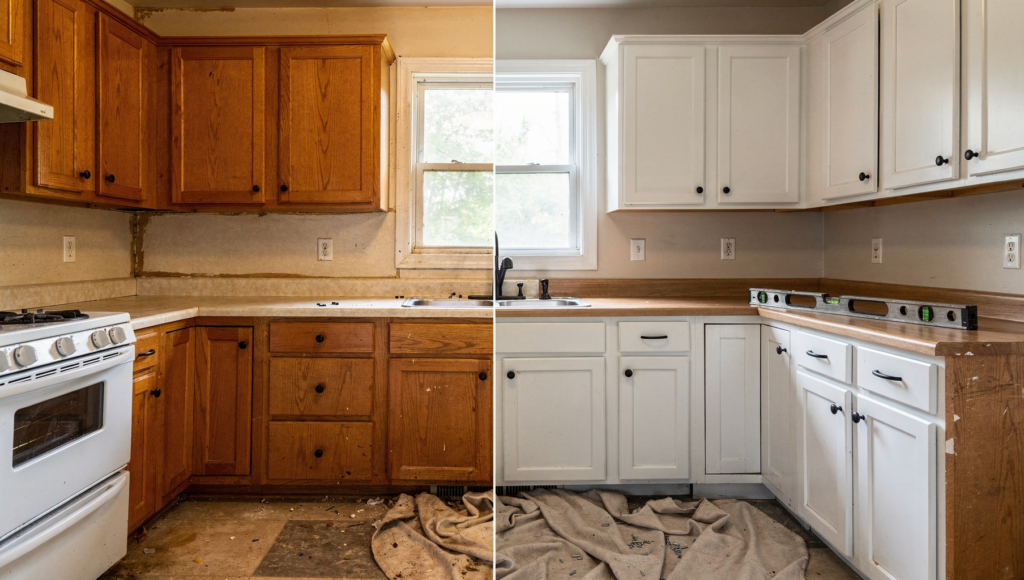
You have seen the house. Good bones, right street, priced well below the block because the kitchen is from 1987 and the roof is tired. You can see what it could be. You just cannot see how to pay for both the house and the work.
That is exactly the problem a renovation loan solves. Instead of scraping together a down payment and then finding another $40,000 for the kitchen, you finance the purchase and the improvements in a single loan, at one closing, with one payment. And here is the part that makes it work: the loan is sized against what the home will be worth after the work is done, not what it is worth today.
That one mechanic is why renovation loans open doors that cash and HELOCs cannot.
How a renovation loan actually works
A normal mortgage is based on the home’s current appraised value. If the house appraises at $280,000, that is what the lender lends against, dated kitchen and all.
A renovation loan uses an “as-completed” or “after-improved” appraisal. The appraiser reviews your contractor’s plans and bids, then values the home as if the renovation is already finished. If that same house appraises at $360,000 once the work is done, your loan is sized against the higher number. The gap between the two is what funds your project.
The money does not land in your bank account at closing. It goes into a controlled escrow account and gets released to your contractor in stages, called draws, as work is completed and inspected. Foundation, framing, rough-in, final. Each milestone gets verified before the next payment goes out.
That structure protects everyone, you included. It is also why renovation loans take more coordination than a standard purchase, and why you want a lender who has actually closed them.
The 110% rule, and why it matters
There is a specific piece of the FHA 203(k) formula worth understanding, because it is the part that makes the whole thing possible.
FHA sizes a 203(k) loan using the lesser of two numbers: the home’s as-is value plus your financeable renovation costs, or 110% of the after-improved value. Whichever is smaller becomes the basis. Your loan-to-value factor then applies on top, up to 96.5% on a purchase, and the whole thing still has to fit under the FHA loan limit for your county.
Read that again, because it is unusual. FHA will let the calculation run to 110% of what the home will be worth when the work is finished. Almost every other mortgage on the market caps you at the value the house has today. That extra headroom exists for a practical reason: renovation costs and value added are not the same number. A $60,000 kitchen does not always add $60,000 to an appraisal. The 110% ceiling gives the math enough room to absorb that gap instead of killing the deal over it.
Two caveats so nobody gets the wrong idea. This is a ceiling inside a formula, not a check for 110% of your future home value. And on condominiums the figure is 100%, not 110%.
But the principle is the real headline: on a 203(k), you are borrowing against a house that does not exist yet. That is not a loophole, it is the design.
The main programs
Three paths cover most situations in Georgia.
FHA 203(k) Limited
For smaller, non-structural projects. Think kitchen and bath updates, flooring, paint, HVAC replacement, roofing, windows, appliances.
- Renovation budget capped at $75,000 (raised from $35,000 by HUD in 2024)
- No structural work
- No HUD consultant required, which keeps it simpler and faster
- FHA credit flexibility, with down payments as low as 3.5%
This is the workhorse for cosmetic-to-moderate updates. HUD raised this cap from $35,000 to $75,000 in 2024, which pulled a lot of real projects into reach that previously did not fit. If your project is a kitchen, a bathroom, some flooring, and a roof, this is very likely your program.
FHA 203(k) Standard
For bigger projects and anything structural: moving walls, additions, foundation work, major systems.
- No cap in the same way, though FHA county loan limits still apply
- A HUD consultant oversees the project and the draw schedule
- Structural work allowed
- If the home is uninhabitable during construction, you can often finance up to twelve months of mortgage payments into the loan, which is enormously practical when you cannot live there and pay rent somewhere else at the same time
Fannie Mae HomeStyle
The conventional option, and the most flexible on what you can build and what you can buy.
- Works on primary residences, second homes, and one-unit investment properties. The FHA programs require you to live there.
- Allows improvements FHA will not touch, including pools, detached garages, and outdoor kitchens
- No FHA mortgage insurance. If your loan-to-value lands under 80% after improvements, there may be no monthly mortgage insurance at all
- Tighter credit and debt-ratio standards than FHA, so it favors stronger borrowers
- Down payments start around 5%, or as low as 3% for first-time buyers pairing it with HomeReady
There is a Freddie Mac equivalent called CHOICERenovation with a similar profile, and a limited version of HomeStyle for smaller projects that skips the consultant and draw complexity.
The right program depends on your credit, your down payment, whether you will live there, and what you are actually building. That is four variables, which is precisely why this is a conversation and not a web form.
Why not just use cash or a HELOC?
Fair question, and sometimes those are better. Here is the honest comparison.
A HELOC requires equity you already have. If you are buying the fixer-upper, you do not have equity in it yet. HELOCs work beautifully for renovating a home you have owned for years, and we cover that tradeoff in our guide to tapping home equity. They do not solve the purchase-plus-renovation problem.
Cash works if you have it. Most buyers who can cover a down payment cannot also cover a $50,000 kitchen, and draining every account to do it leaves you with a beautiful kitchen and no emergency fund.
A renovation loan is the tool built for this specific situation: you do not own the home yet, or you do not have the equity yet, and the value you need does not exist until the work is done.
The trade is complexity. More documentation, contractor approval, a draw process, and a longer timeline. That is real, and worth it when the math works.
Where these loans go sideways
Being straight with you, because this is where people get burned.
Contractor selection. Your contractor has to be licensed and approved, and they have to be willing to work within a draw schedule, meaning they get paid as milestones complete rather than up front. Some good contractors do not want the paperwork. Find that out before you are under contract, not after.
Scope creep. The budget is locked at closing based on approved bids. Deciding halfway through that you also want to redo the primary bath is not a simple change. Get the scope right the first time.
Timeline. These take longer than a standard purchase. More approvals, more moving parts. Build that into your offer and your expectations.
Self-performed work. Mostly not allowed. Renovation programs generally require licensed contractors, with narrow exceptions. If your plan depends on doing the demo yourself, ask first.
None of this is a reason to avoid renovation loans. It is a reason to go in with your eyes open and a lender who will tell you the truth about the timeline instead of what you want to hear.
Is a renovation loan right for you?
It tends to be a strong fit when:
- You found a well-located home priced below the block because of condition
- The improvements will add real value, not just personal preference
- You have a contractor you trust who will work within the process
- You would rather do it once, correctly, than live in a project for five years
It tends to be the wrong fit when:
- You need to close fast in a competitive multiple-offer situation
- The work is genuinely cosmetic and cheap enough to cash-flow
- You are counting on doing the work yourself
- You want the flexibility to change your mind mid-project
If you are looking at a home that needs work and you are not sure which way to go, that is a fifteen-minute conversation. Sometimes the answer is a straightforward FHA loan and a credit card for the paint. Sometimes it is a 203(k). We will tell you which.
Frequently asked questions
What is a renovation loan and how does it work?
A renovation loan finances a home purchase or refinance plus the cost of improvements in a single loan with one closing. The loan is sized using an as-completed appraisal, meaning the home is valued as if the renovation is already finished. Funds are held in escrow and released to your contractor in stages as work is completed and inspected.
What is the difference between FHA 203(k) Limited and Standard?
Limited is for non-structural projects with a renovation budget capped at $75,000, and it does not require a HUD consultant. Standard handles larger and structural projects, requires a consultant to oversee the work and draws, and can finance up to twelve months of mortgage payments if the home is uninhabitable during construction.
Can I use a renovation loan on an investment property in Georgia?
Not with FHA 203(k), which requires you to live in the home. Fannie Mae HomeStyle does allow one-unit investment properties and second homes, which makes it the usual choice for a renovation on a property you will not occupy.
Can I do the renovation work myself?
Generally no. Renovation programs typically require licensed, approved contractors, with narrow exceptions for certain minor items and heavy documentation. If your plan depends on self-performed work, raise it with your lender before you go under contract.
How much can I borrow with an FHA 203(k) renovation loan?
FHA sizes the loan using the lesser of two numbers: the home’s as-is value plus your financeable renovation costs, or 110% of the after-improved value. Your loan-to-value factor applies on top, up to 96.5% on a purchase, and the total still has to fall under the FHA loan limit for your county. The 110% ceiling is what lets the math work when renovation costs exceed the value they add.
Is a renovation loan better than a HELOC?
They solve different problems. A HELOC requires equity you already have, so it works well for renovating a home you have owned for a while. A renovation loan works when you are buying the home or do not yet have the equity, because it lends against the after-improved value rather than today’s value.
Let’s find out what that house could actually be
The right fixer-upper in the right neighborhood is one of the best values left in Georgia real estate. The financing is the part people get stuck on, and it is the part we do every day.
See our renovation loan program, then send us the address and your rough scope. We will tell you which program fits, what it will take, and whether the numbers work before you write an offer. No credit pull until you are ready.
Or call us at (770) 928-8985.