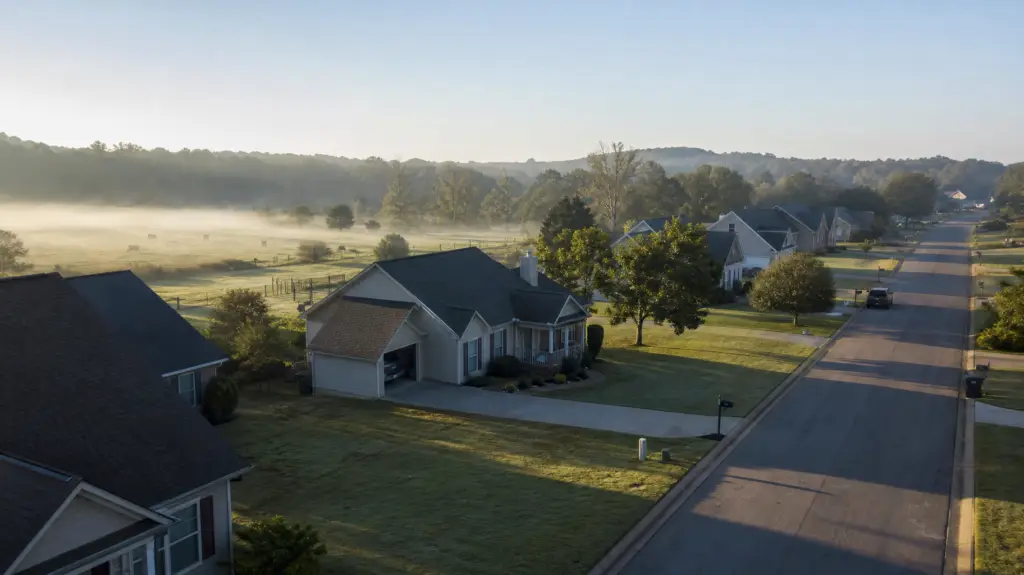
Here is a program that lets qualified Georgia buyers purchase a home with no down payment, at competitive rates, with monthly costs lower than an FHA loan. And most people scroll right past it because of one word in the name: rural.
The word is misleading. “Rural” in USDA terms does not mean a farm at the end of a dirt road. Plenty of established towns and outer suburbs across Georgia qualify, including places most people would never describe as rural. If you are house hunting outside the immediate metro core, there is a real chance the home you are looking at is eligible and nobody has mentioned it.
This guide covers how USDA loans work in Georgia in 2026, the two tests you have to pass, and how to find out in about five minutes whether you qualify.
What a USDA loan is
A USDA loan is a mortgage backed by the U.S. Department of Agriculture through its Rural Development program. The version almost everyone uses is the Section 502 Guaranteed Loan: a private lender funds it, and the federal government guarantees it.
That guarantee is what makes zero down possible. And unlike a VA loan, you do not need military service. You just need to meet two tests: the property has to be in an eligible area, and your household income has to fall under the limit.
The benefits, honestly
Zero down payment. Full 100% financing. For buyers whose savings are the only thing holding them back, this is the whole ballgame.
Cheaper monthly costs than FHA. This is the part that gets overlooked. USDA charges a 0.35% annual guarantee fee, paid monthly. FHA’s annual mortgage insurance runs considerably higher and usually lasts the life of the loan. On the same purchase price, a USDA loan typically carries a noticeably lower monthly payment.
Competitive rates. USDA rates tend to run at or below conventional pricing thanks to the government backing.
No loan limit. USDA does not publish county loan limits the way FHA does. What you can borrow is determined by your income, debts, and ability to repay.
For a buyer who qualifies for both USDA and FHA, USDA usually wins on cost. The catch is that the eligibility rules are stricter, which is exactly why the two tests matter so much.
Test one: is the property in an eligible area?
Forget your mental image of “rural.” The USDA defines eligible areas using population, proximity to metro areas, and access to mortgage credit. In practice, a large share of Georgia’s land area qualifies.
What generally does not qualify: the built-up cores of Atlanta, Savannah, Augusta, Columbus, and Macon, plus their dense inner suburbs.
What often does qualify: smaller towns, outer suburbs, and communities on the edges of metro areas across the state. Buyers are regularly surprised by what makes the cut.
You cannot eyeball this. Eligibility is drawn address by address, and two homes a mile apart can land on opposite sides of a line. Check the specific address on the USDA’s property eligibility site, or send it to us and we will run it before you write an offer. That five-minute check has changed a lot of people’s plans.
Test two: is your household income under the limit?
The USDA is built to serve low- and moderate-income households, so there is a hard income ceiling set at 115% of the area median income for the county.
For 2026, the standard limits in most areas are:
- $119,850 for households of 1 to 4 people
- $158,250 for households of 5 to 8 people
Some higher-cost counties, including certain counties around Atlanta, carry higher limits. Households larger than eight get an additional increase per member.
Two details that trip people up, and they cut in opposite directions:
The bad news: USDA counts the income of every adult in the household, not just the people on the loan. If your adult brother lives with you and works, his income counts toward the limit even though he is not a borrower. This surprises people constantly.
The good news: the USDA allows deductions that can pull you back under the line, including adjustments for childcare expenses, elderly household members, and dependents who are full-time students. If you are close to the limit, do not assume you are out. The adjusted number is what matters, and running it properly is a lender’s job.
What it costs
USDA loans do not carry traditional mortgage insurance. Instead, there are two guarantee fees:
- Upfront guarantee fee: 1% of the loan amount. On a $250,000 loan, that is $2,500. It can be rolled into the loan rather than paid in cash, which is how most buyers handle it.
- Annual guarantee fee: 0.35% of the remaining principal, divided by twelve and included in your monthly payment.
That 0.35% is the number to remember. It is meaningfully cheaper than FHA’s annual premium, and it is the reason USDA often produces the lowest monthly payment of any zero-down option for a buyer who qualifies.
The other requirements
Credit. The USDA does not publish a hard minimum score. Most lenders look for around 640 for streamlined automated underwriting. Below that, manual underwriting is sometimes possible with stronger documentation and compensating factors.
Debt ratios. USDA generally targets a housing payment around 29% of gross monthly income and total debt around 41%. These can stretch with strong compensating factors like good credit or reserves.
Primary residence. The home has to be where you live. USDA is not for investment properties or vacation homes.
The appraisal. USDA requires an appraisal confirming the home meets Minimum Property Requirements for safety, soundness, and livability, similar in spirit to an FHA appraisal.
Employment. Generally a two-year history, though it does not need to be with the same employer, and recent graduates get some latitude.
USDA versus the alternatives
If you are weighing options, here is the quick version.
USDA vs. FHA: If you pass both USDA tests, USDA usually wins. Zero down instead of 3.5%, and lower monthly fees. FHA takes over when the address is not eligible or your income is over the limit.
USDA vs. VA: If you are a veteran, VA is usually the better deal. No down payment, no monthly fee at all, and no income or geographic limits.
USDA vs. conventional: Conventional makes sense with strong credit and a real down payment, since you can cancel mortgage insurance at 20% equity and there are no location or income restrictions.
This is a genuine fork in the road, and it is why we price multiple programs on every file rather than assuming. Sometimes the answer surprises us too.
How to find out if you qualify
- Check the address. Run the specific property through the USDA eligibility site, or send it to us.
- Add up household income. Every adult in the home, gross, before deductions. Then ask about the adjustments.
- Get pre-approved. We confirm both tests, look at credit and ratios, and hand you a pre-approval letter.
- Shop and close. Once you are under contract, the USDA appraisal and lender underwriting run in parallel. Expect roughly 30 to 60 days.
If USDA does not fit, it is not the end of the road. There are other low-down-payment paths for first-time buyers in Georgia, and we will walk you through them honestly.
Frequently asked questions
Do I have to live in the country to get a USDA loan in Georgia?
No. “Rural” is a technical designation, not a description. Many small towns and outer suburban areas across Georgia are eligible, including places most people would not call rural. Eligibility is determined address by address, so check the specific home rather than assuming.
What are the USDA income limits for 2026?
In most areas, the limit is $119,850 for households of 1 to 4 people and $158,250 for households of 5 to 8. Some higher-cost counties allow more. The USDA counts income from all adults in the household, not just borrowers, but allows deductions for childcare, elderly members, and student dependents.
Do USDA loans require mortgage insurance?
Not traditional mortgage insurance. USDA charges a 1% upfront guarantee fee, which can be rolled into the loan, plus a 0.35% annual fee paid monthly. That annual fee is lower than FHA’s mortgage insurance, which is why USDA often has a cheaper monthly payment.
What credit score do I need for a USDA loan?
The USDA does not set a hard minimum. Most lenders look for about 640 to use streamlined automated underwriting. Scores below that can sometimes be approved through manual underwriting with additional documentation and compensating factors.
Is a USDA loan better than an FHA loan?
If you qualify for both, USDA usually costs less: zero down instead of 3.5%, and lower monthly fees. FHA becomes the better option when the property is not in an eligible area, your household income exceeds the limit, or your credit needs FHA’s flexibility.
Find out in five minutes whether your address qualifies
The only thing standing between a lot of Georgia buyers and a zero-down mortgage is a quick eligibility check nobody ever ran for them. It costs nothing to find out.
See our USDA loan program, or just send us the address and we will tell you straight whether it qualifies and what your options look like either way. No credit pull until you are ready.
Or call us at (770) 928-8985.